Information
This is the homepage of our paper “Socialality Anchors: Towards Group-bounded Trajectory Prediction”. The paper is now available on arXiv. Click the buttons below for more information.
Abstract
Trajectory prediction is a key component for understanding human behavior patterns in dynamic scenes. Researchers have devoted substantial efforts to modeling social interactions, especially group-wise interactions, since group membership often reflects shared intention, coordinated motion, and stable mutual adaptation, thus providing a persistent and semantically meaningful social prior for forecasting. However, existing group modeling methods may rely on a fixed threshold and infer groups mainly from agents’ relative positions within the observation window, overlooking the fact that grouping rules should be agent-specific, temporally coherent, and context-adaptive across diverse personalities, culturalities, and evolving interaction contexts. Inspired by human social perception that alternates between interpersonal distance in boundary-sensitive situations and relative speed consistency in dynamic interactions, we propose Socialality, a human-inspired trajectory prediction framework with interpretable socialality anchors and an extended grouping window for stable, context-aware grouping inference. Concretely, Socialality introduces a duo-scalar-controlled grouping kernel Socialality that jointly leverages historical observations and short-term future trajectory previews to learn agent-specific grouping rules, and employs a group-wise perception mechanism to model in-group and out-of-group interactions in an intuitive and explainable manner. Furthermore, we conduct extensive experiments on standard benchmarks to demonstrate the performance gains of Socialality, and provide qualitative analyses and statistical studies of anchor distributions to verify the interpretability and stability of the proposed socialality anchors.
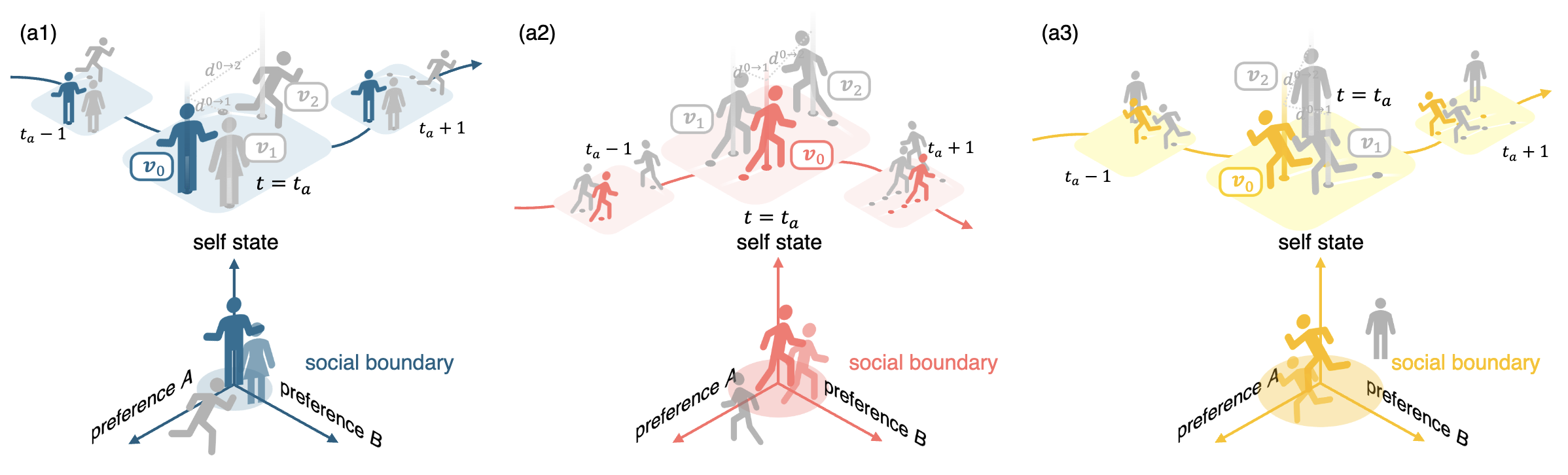
Fig. Motivation Illustration: By observing the agent-wise preferences when grouping with others over a period of time, we mainly focus on how to infer each target agent’s social boundary, which will anchor its group affiliation.
Contributions
In summary, our main contributions are as follows:
- We propose a socialality-anchors-controlled grouping kernel that simultaneously considers both agents’ historical observations and their short-term future trajectory previews to learn to interpret agent-specific, context-adaptive social boundaries with temporal coherence, thus obtaining the group priors.
- We propose the Socialality trajectory prediction model that inherits the perception mechanism to explicitly takes the group priors interpreted from socialality kernel into account to simulate group-wise social interactions modulated by the newly proposed socialality anchors in a human-inspired way.
- We conduct experiments on standard benchmarks to demonstrate the performance gain of Socialality, and further provide qualitative analyses together with statistical studies of anchor distributions to verify the interpretability and stability of the proposed socialality anchors.
Citation
If you find this work useful, it would be grateful to cite our paper!
@article{zou2026socialality,
  title={Socialality Anchors: Towards Group-bounded Trajectory Prediction},
  author={Zou, Ziqian and Wong, Conghao and Peng, Qinmu and You, Xinge},
  journal={arXiv preprint arXiv:2609.36852},
  year={2026}
}
Contact us
Ziqian Zou (@LivepoolQ)
Conghao Wong (@cocoon2wong)